


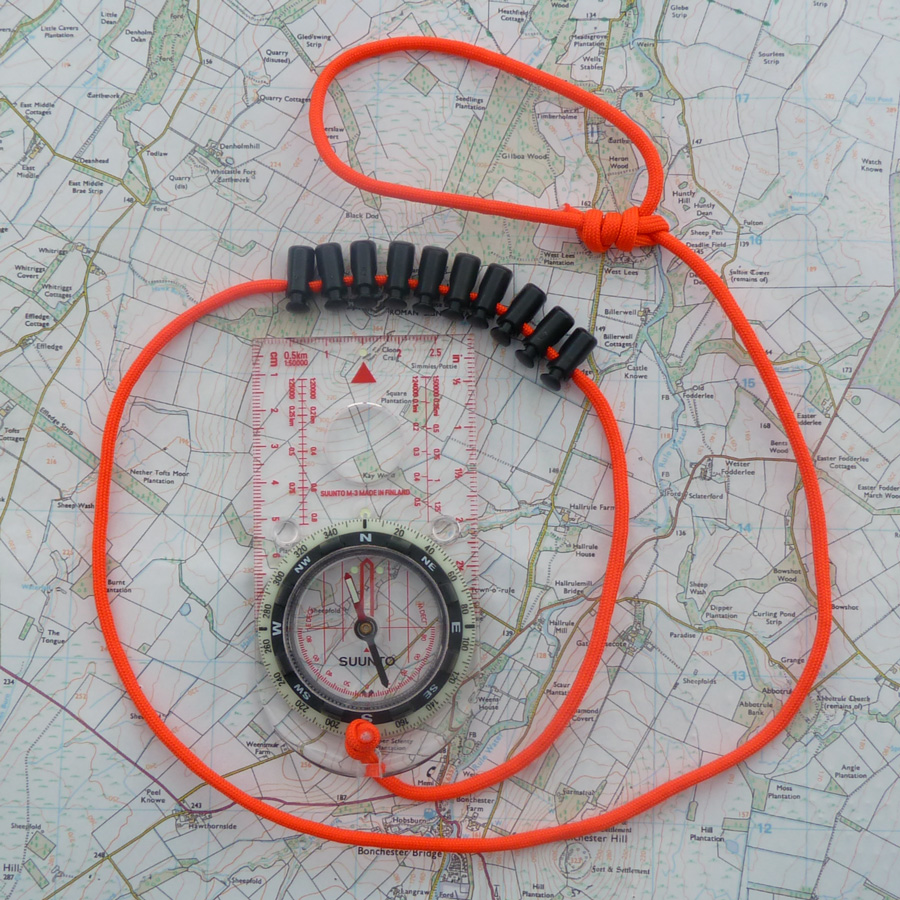


Description
Pacing Tally Counter Locking Toggles (set of 10)
Perfect for making a pacing counter! Simply slip 10 of these locking toggles onto a 1.2 length of paracord, attach it to your rucksack and move one down every 100 m you walk.
The price of £2.49 is for a set of 10 toggles giving you enough toggles to cover 1 kilometre – 1 toggle per 100m paced!
Pacing
On level ground we each walk a natural number of steps in a given distance.
In land navigation we determine how many paces it takes for you personally to walk 100 m, this is called your Pacing Count, or your PC. This known number of steps can be used to determine how far you have travelled. This system of navigation is called Ded Reckoning and is one of the most important techniques you will learn. It is often used in poor weather/visibility and at night.


Determining your Pacing Count
Select a level piece of ground, a football pitch is ideal. Use your map to measure 100 m or better still, measure it out with your distance lanyard.
- From your starting line walk at your normal pace and count your double step – if you start by putting your left leg forward first, count every step thereafter of your right foot only – this is a double step and counts as one pace.
- Stop at the end of the distance and record this number.
- Repeat this, as you need to relax into your stride, and make sure that you are both counting and pacing consistently.

This number of paces is your personal PC (typically this varies from 55, for very tall people, to 75, for people with short legs). You now know your personal PC
Calculating distance travelled ≤ 100 m
Now you know your own PC on this terrain, you can predict how many paces you will need to cover say 50 m (PC divided by 2) or 25 m (PC divided by 4).
Calculating distance travelled ≥ 100 m
When travelling further than 100 m it is easy to lose count so the technique employed is to count 100 m then, without stopping, start recounting your paces from one. Record each 100 m travelled on your tally counter.

Roger –
Neat items, and a good alternative to a handful of pebbles.
T Murphy –
Tally ho. Just the job.
Tarja –
Ideal for pacing. Orange so can be seen – smaller than I expected so recommend narrow paracord.
Scott Amos –
Thanks for the review Tarja, much appreciated. Our paracord is the real McCoy Military 5040 Type 3 constructed from 7 inner strands with a 32 plait braided cover, giving it a remarkable minimum breaking strain of 550lb, hence its name, yet only 3.8mm in diameter!
Ingrid Lohr –
Perfect for pacing. Good size, not too big, not too flimsy. Like it. 🙂
Ajay –
Like the orange colour. A bit smaller than I’d like for use with winter gloves.
Victor Allen –
Just completed a navigation course with a couple of guys who are part of the mountain rescue fraternity.
They both agreed that pacing and timing are amongst the most important skills that every navigator should employ whilst out with the map and compass.
These locking toggles attached to a 4mm paracord were exactly what they were using on my course and because of that, they are what I purchased to help my navigation improve.
A terrific piece of kit ordered, and delivered in just a few days and highly recommended.
Sam Ravenwolf –
Absolutely great – so simple, yet so effective. And as always from Scott a very generous and reasonable price.
Love the orange and black contrast.
Keeping count – whether forward or back-tracing.
I’m going to try and get some illuminous stickers for each toggle for night time navigation.
(Searched for luminous toggles but to no avail).
For anyone with Cervical Radiculopathy symptoms (inc Hands/fingers: poor sensation, grip and strength) these toggles are managable, and
just about big enough to glue a small section of grip/racket tape/or wound small elastic band on to assist if req’d.
Many thanks again Scott!
Awesome!